
€23.6 Billion in Tourism Revenue: What It Actually Means for Rental Yield in Athens
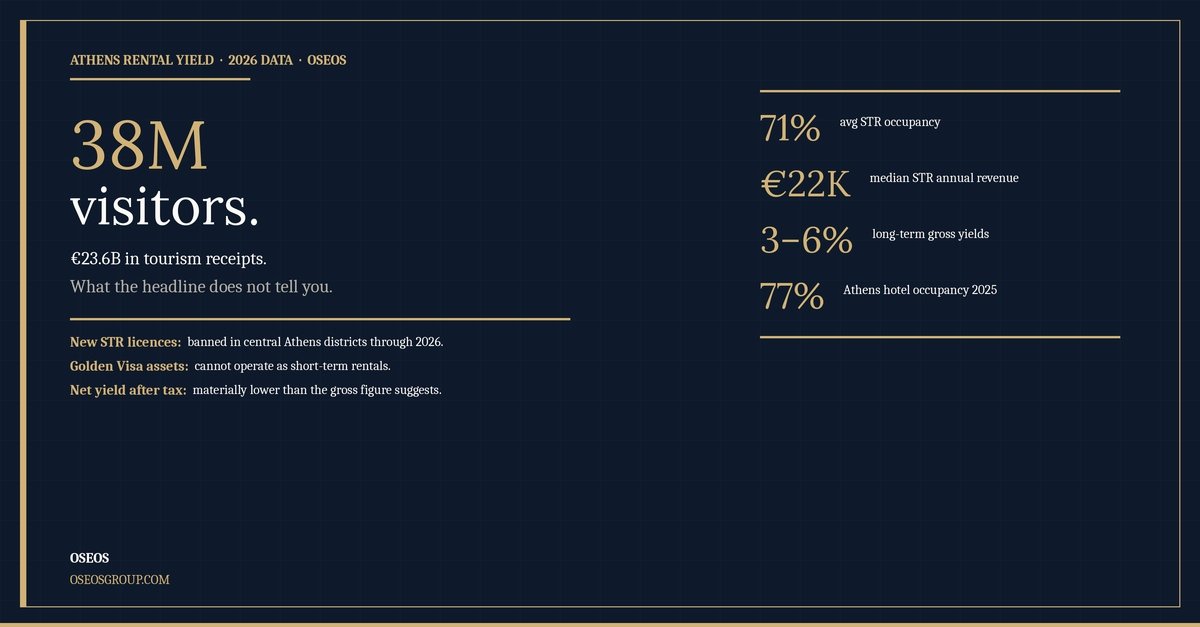
Greece recorded close to 38 million international arrivals in 2025, alongside approximately €23.6 billion in travel receipts. Athens alone generated short-term rental tax revenues approaching €1 billion in the same year. The numbers are striking. The question worth asking is what they actually mean for an investor evaluating a Greek property in 2026 and the honest answer is more nuanced than the headline suggests.
The Demand Picture Is Genuinely Strong
Start with what is real. Athens International Airport handled a record 34 million passengers in 2025, surpassing its 2019 pre-pandemic total by 33%. Tourism receipts in the Attica region grew nearly 24% in the first three quarters alone, faster than any other region in Greece.
Crucially, Athens is no longer a seasonal market. December 2024 saw tourist numbers increase 15.3% with revenue jumping 33.3%, supporting stable rental income outside peak seasons. The year-round demand profile is a meaningful shift from the summer-concentration model that defined Greek tourism for decades.
A typical short-term rental in Athens currently achieves a median revenue of €22,000 per year, with an occupancy rate of 71%. Short-term rentals are at an all-time high across Greece, with nearly a quarter of a million active listings and more than one million available beds.
The demand side of this equation is not in question.
The Supply Side Has Tightened and That Is a Two-Sided Story
Effective January 1, 2025, the Greek government halted all new short-term rental registrations in Athens’ 1st, 2nd, and 3rd municipal districts an area encompassing Kolonaki, Koukaki, Pangrati, and Exarchia, with the moratorium lasting at least one year and strong indications of extension.
This is the detail that changes the calculus for new investors in two important ways.
If you already hold a registered short-term rental licence in a restricted zone, that licence is now a scarce asset. Properties that secured licences before the freeze now trade 15–25% above comparable unlicensed properties. The freeze has created a supply constraint that reinforces the value of existing, compliant inventory.
If you are buying now in a restricted zone with the intention of running a short-term rental, you cannot get a new licence. The window closed December 31, 2024. A narrow grandfathering provision existed for properties under renovation with registration by that date, but this window has now closed.
This means new investors in central Athens face a clear choice: pay a 15–25% premium for a property that already holds an active licence, or pivot to a long-term rental strategy.
The Golden Visa and Short-Term Rental Conflict
This is the detail most developers in this market will not volunteer.
Golden Visa properties acquired after September 1, 2024 cannot legally operate as short-term rentals. This applies regardless of whether the property is in a restricted zone or not. The legislation that restructured the Golden Visa investment thresholds in September 2024 explicitly excluded short-term rental operation as a permitted use for qualifying properties.
For investors combining a Golden Visa application with a rental income strategy, this means the two cannot be structured around the same property. The Golden Visa asset and the income-generating asset need to be separate which changes the capital requirement and the structure of the investment materially.
Anyone who has been told their Golden Visa property will generate short-term rental income from day one should verify this with a qualified Greek lawyer before proceeding.
What the Yield Numbers Actually Look Like by Neighbourhood
Gross yield figures in Athens vary significantly by location, property type, and rental strategy. Here is what the current data shows:
Piraeus and inner Faliro offer long-term gross yields of 5–6.5% at entry prices around €2,400 per square metre, with short-term rental yields of 6–8% where licensed.
Kypseli offers approximately 5.4% gross yield, while Exarchia-Neapoli sits at around 4.8% gross. Both are in the registration freeze zone for short-term rentals, meaning these figures reflect long-term rental performance for new buyers.
Kolonaki offers lower but more stable yields around 4.36%, while Koukaki provides approximately 4.88% gross yields. Both are in the freeze zone.
For long-term rentals across the restricted districts, net yields of 3–4% are realistic after costs, compared to 5–7% previously achievable through short-term rentals before the moratorium.
The important caveat on all gross yield figures: they do not account for the full cost stack.
The Honest Numbers on Net Yield
For a property generating €30,000 in annual rental income, the total annual tax burden frequently exceeds €9,000, representing over 30% effective rates before operating expenses, management fees, or maintenance. Compliance costs for short-term rental registration run €2,000 to €5,000 upfront, with ongoing annual expenses of €800 to €1,500.
A property earning €22,000 gross in a well-located central Athens area, after Greek income tax, the Climate Crisis Resilience Fee, ENFIA property tax, management fees of 15–20%, and maintenance, will net considerably less than the headline figure suggests.
This is not a reason to avoid the market. It is a reason to model net returns carefully before committing, not after.
Long-Term Rental as the Default Strategy in 2026
Given the registration freeze, the Golden Visa restriction on short-term use, and the net yield compression after costs, long-term rental is emerging as the more realistic primary income strategy for many new buyers in central Athens.
Long-term rentals offer superior stability with occupancy rates of 90–97%, compared to 70–72% for short-term rentals. The predictable income, lower management burden, and absence of the compliance cost stack make the net yield comparison closer than the gross figures suggest.
Across Athens as a whole, gross rental yields for long-term investment properties range from approximately 3.5% to 6%, with working-class districts offering stronger income returns relative to entry costs.
For investors whose primary objective is Golden Visa eligibility with a secondary income from their property, a long-term rental strategy avoids the legal conflict entirely while delivering predictable returns.
What This Means for How We Think About Asset Selection
At OSEOS, the rental strategy is part of our evaluation of every asset we bring to market not an afterthought. We screen for location, licence status, and asset type with the question of ownership economics built into the analysis from the start.
If a project is positioned for rental income, we model it against the actual net yield, not the gross. If a project is positioned for Golden Visa eligibility, we are clear that the short-term rental income story does not apply. If a project is in a restricted zone, we do not represent that a new licence is available.
The tourism numbers for Greece in 2025 are genuinely impressive. They reflect a mature, year-round demand market that is no longer dependent on summer concentration alone. But the gap between that macro picture and the net return on a specific property is where investment decisions are actually won or lost.

Data sourced from Investropa, Beta Globe, Greek Trip Planner, Airbtics, and Rethinking the Future. Tax and regulatory details are for general informational purposes and subject to change. The short-term rental moratorium and Golden Visa eligibility rules are governed by Greek law. Prospective investors should seek qualified legal and tax advice before making any investment decision.